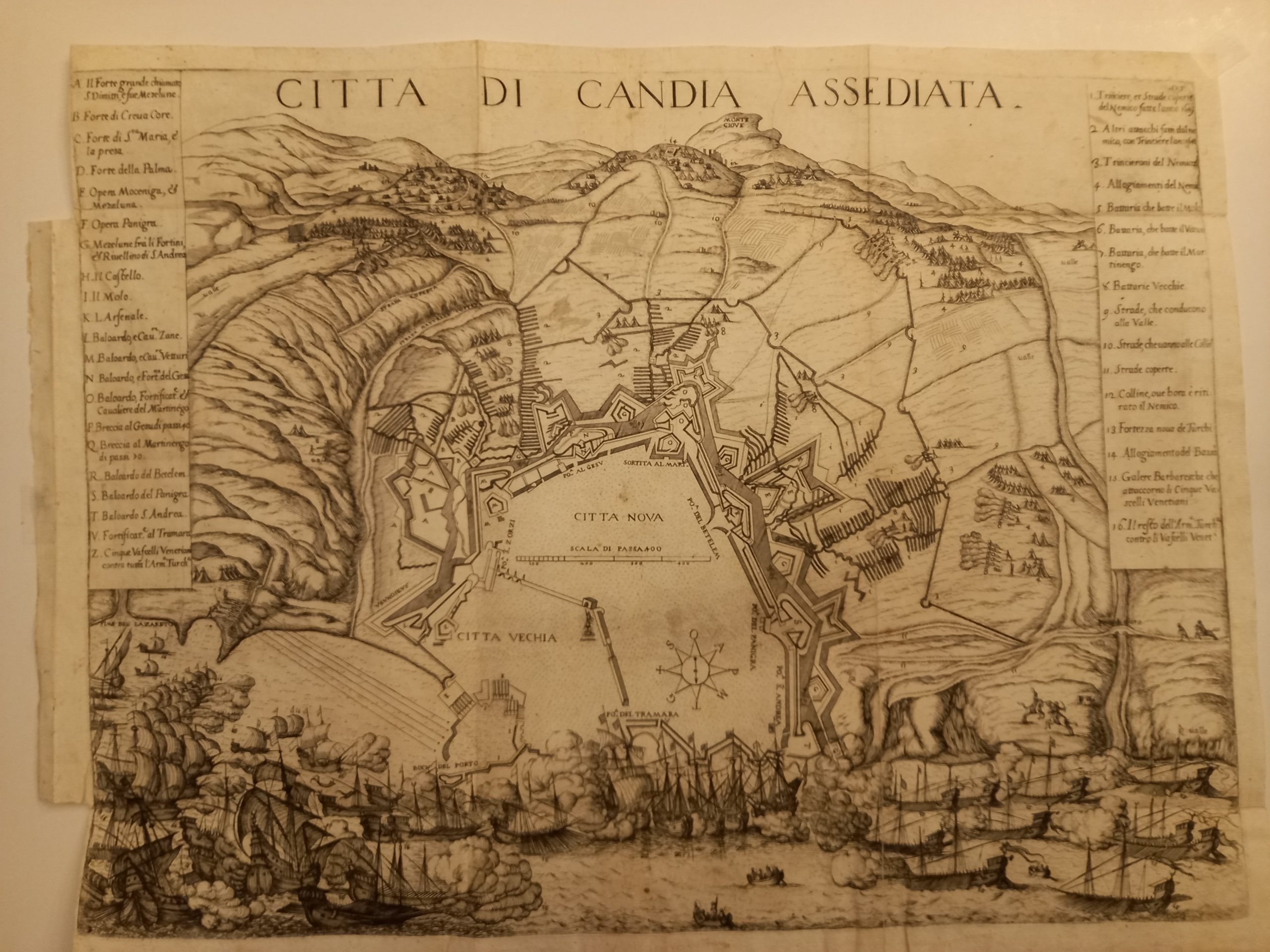
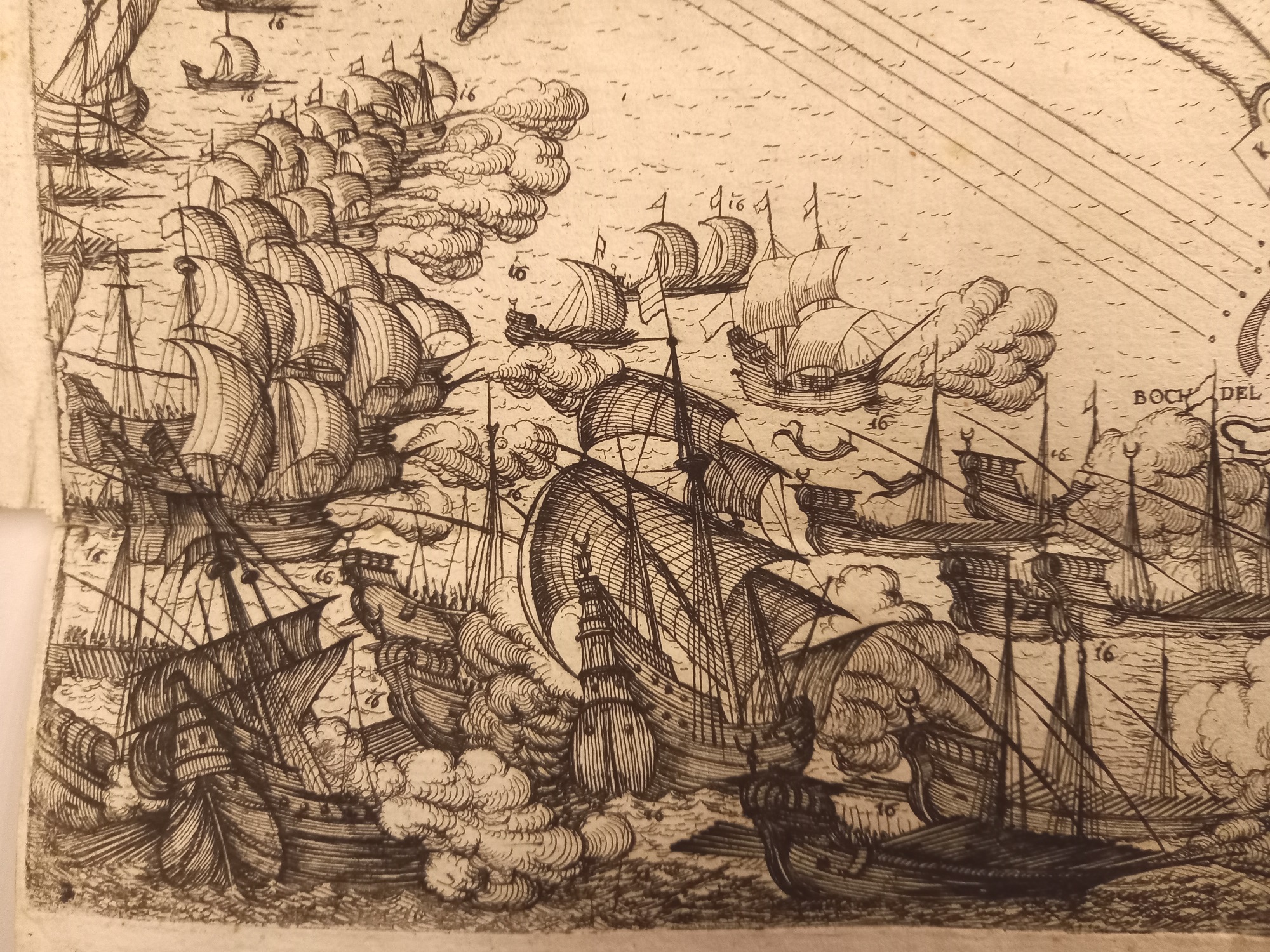
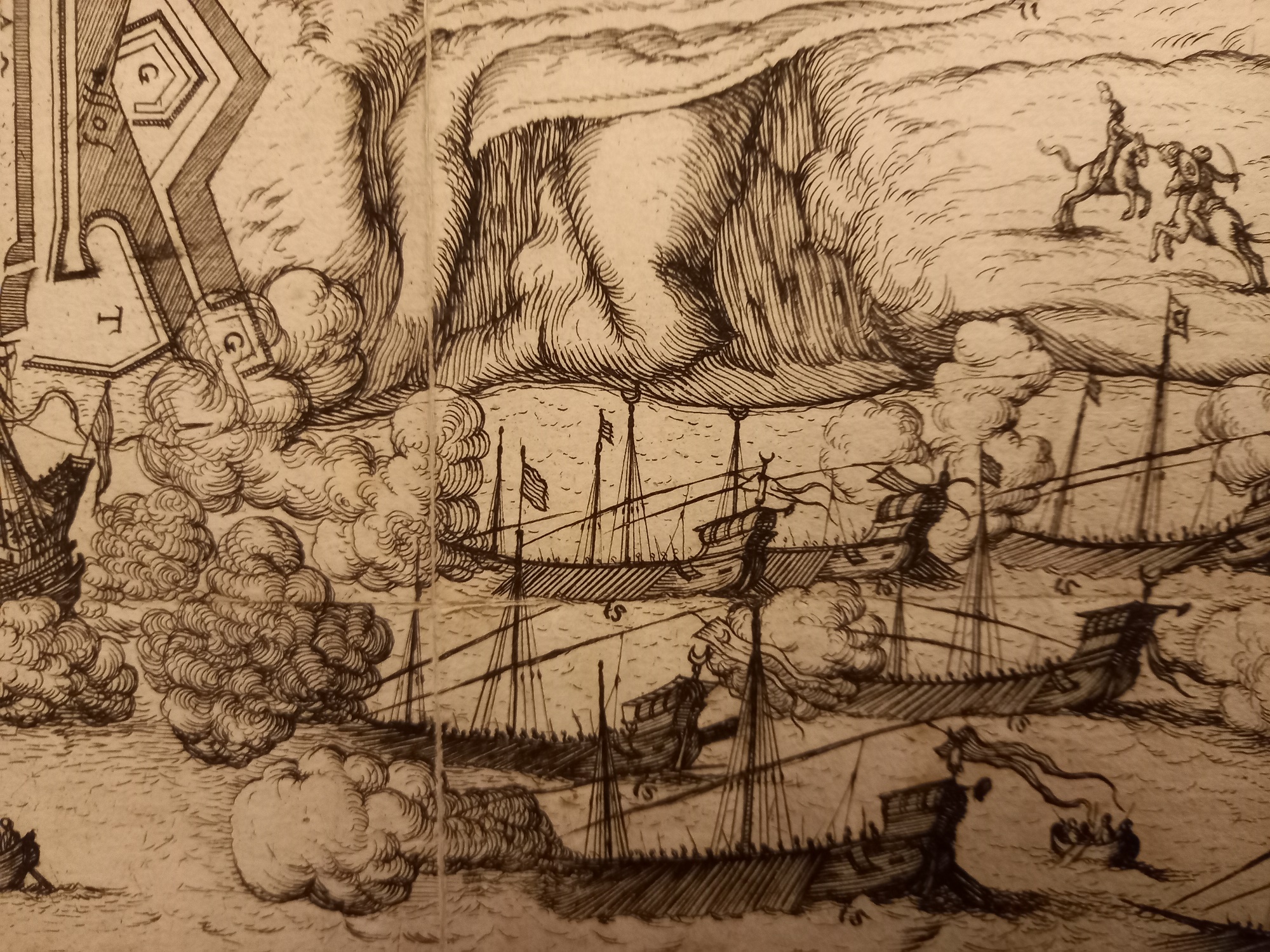
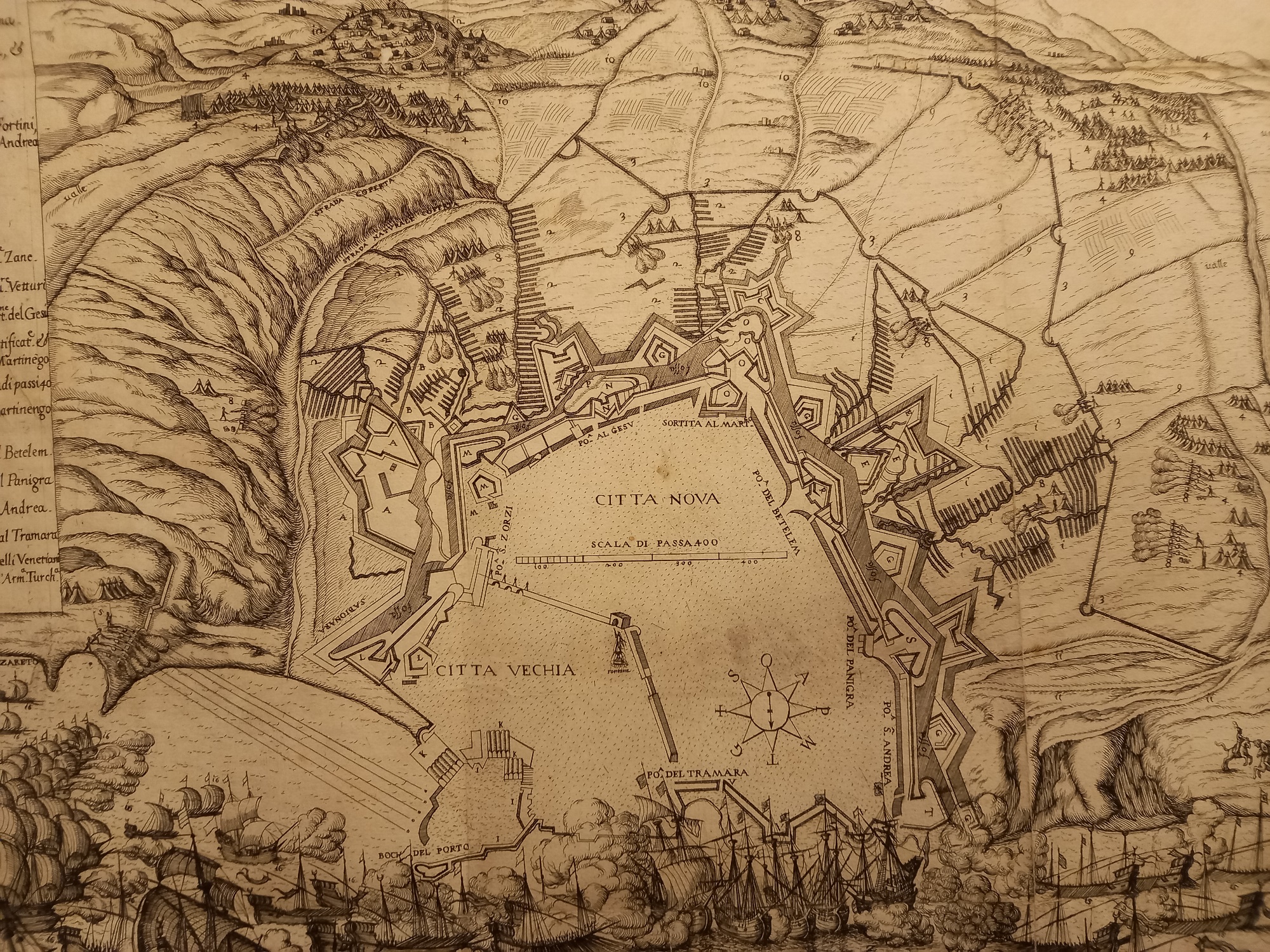
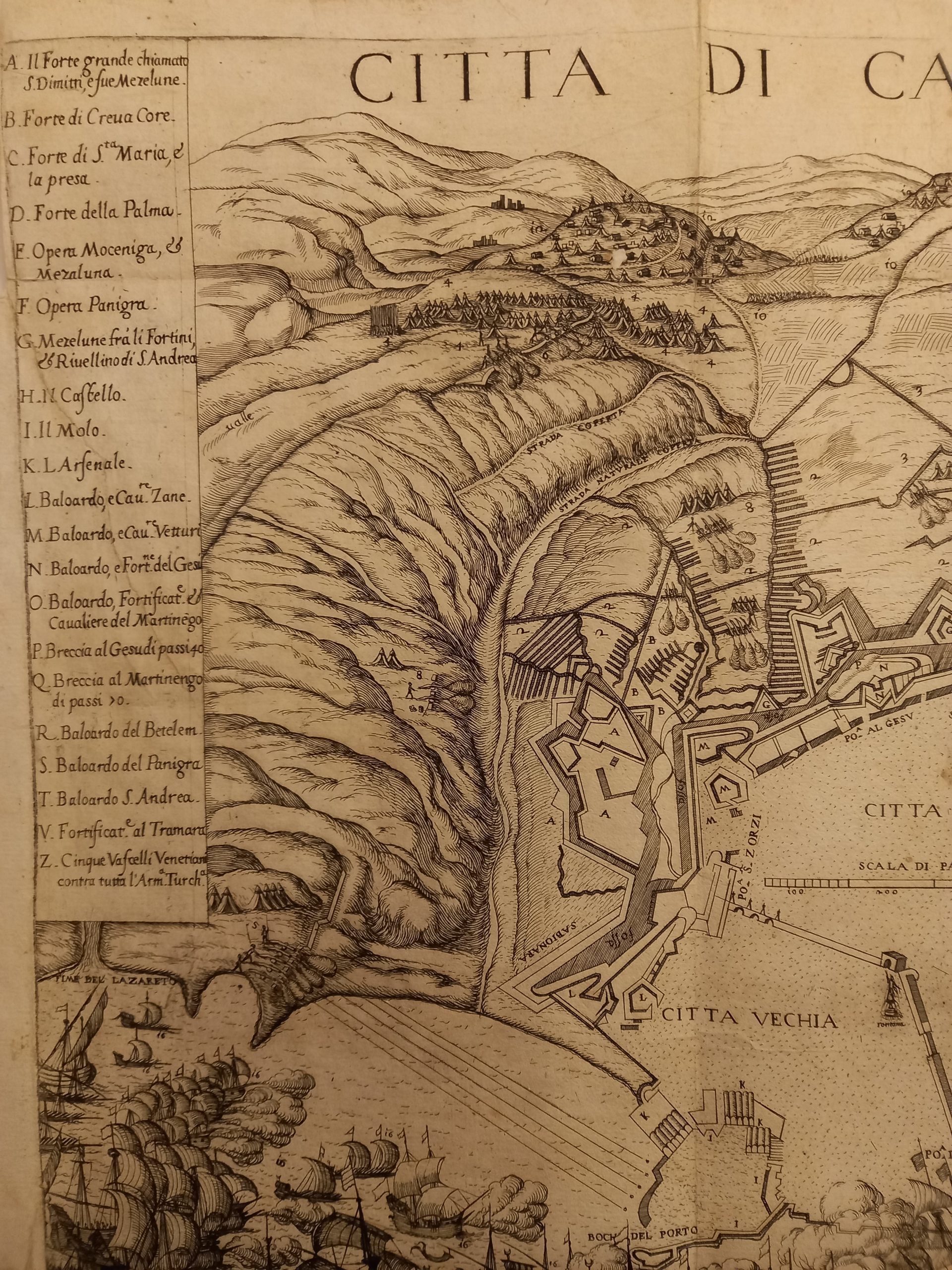
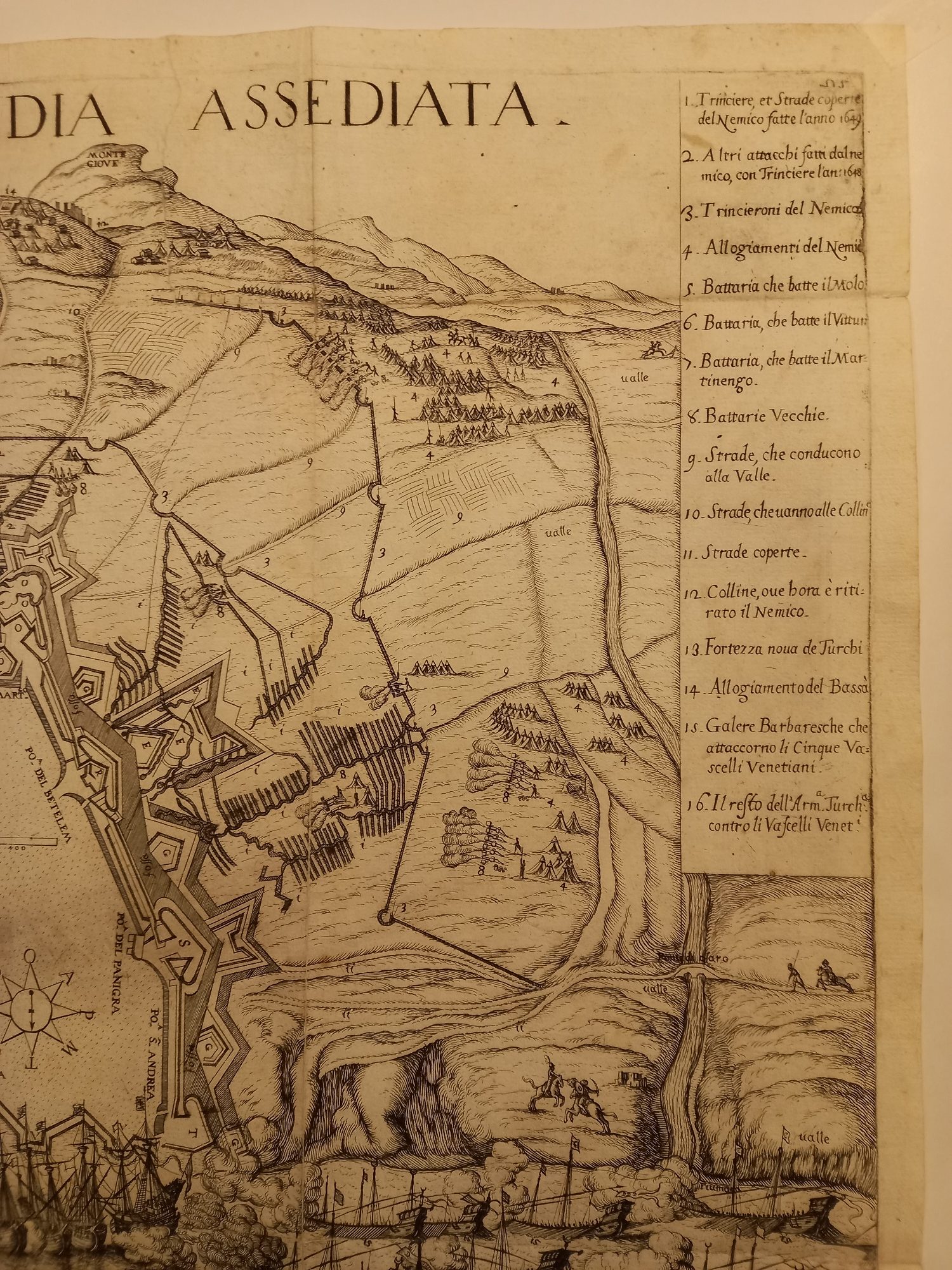
Incisione su rame 559 x 412 mm su foglio 575 x 443 mm. Tratta dal Il regno tutto di Candia delineato a parte, a parte, et intagliato da Marco Boschini venetiano. Durante il XVI secolo l’impero ottomano aveva esercitato una massiccia pressione sul Mar Mediterraneo e nei Balcani, spesso avvantaggiato dall’alleanza francese, giungendo sino in Ungheria. Nel ‘600 la politica dell’impero turco divenne anche più aggressiva, ma con la fine del secolo, le sorti dell’impero erano compromesse, ed esso non costituiva più un pericolo per l’Europa anzi divenne oggetto delle mire espansionistiche dei maggiori stati europei. Infatti, lo stato ottomano rimaneva anacronisticamente fermo alla struttura feudale, mentre i suoi avversari cristiani si organizzavano in regimi accentrati, sostenuti da una solida burocrazia che ne garantiva l’efficienza. I Turchi restarono del tutto estranei al rinnovamento culturale e scientifico che percorse l’Europa. Tale carenza compromise tutta la loro organizzazione tecnica persino nel campo navale. In un paese che faceva della guerra la propria attività fondamentale i sacrifici gravissimi imposti ai piccoli feudatari, tenuti a servire come cavalieri, finirono col rovinarli e coll’esasperarli, sicché gli eserciti diventarono sempre più indisciplinati e meno efficienti. Quando poi i sultani cercarono di sopperire con truppe mercenarie, le spese si moltiplicarono e li costrinsero a ricorrere all’inasprimento fiscale e all’alterazione delle monete, con le inevitabili conseguenze negative sui commerci e sulla produzione. Dal 1645 al 1669 (6 settembre, quando Francesco Morosini negoziò la resa) l’impero ottomano attaccò il possesso veneziano di Candia riuscendo ad impadronirsene, cedendo però alla Serenissima le terre dalmate e albanesi da questa conquistate durante il corso delle operazioni. Boschini Marco scrittore d’arte, pittore e incisore italiano (Venezia 1613-1678 o 1704). La sua opera principale è la Carta del navegar pitoresco (1660), in dialetto veneziano, dedicata all’arciduca Leopoldo Guglielmo e scritta in quartine rimate. Pur continuando la tradizione del dialogo fra l’amatore d’arte e il pittore (in questo caso, l’autore), il testo è diviso in otto parti come la rosa dei venti per meglio orientare il lettore nel mare della pittura veneziana. A Boschini si devono anche la prima vera guida artistica di Venezia, le Ricche minere della pittura veneziana (1674), e una guida di Vicenza (Gioielli pittoreschi della virtuosa città di Vicenza, 1676). Apprezzato incisore e cartografo, nulla rimane della sua attività pittorica. Beautiful condition, lacking three plates, professionally reproduced on old paper. Boschini, a Venetian painter, writer and engraver began work on this survey in 1645, the year the island was invaded by the Turks. When the work was published, the town of Heraklion (Candia) was in the fourth year of what was to become a twenty-two year siege: the topicality of the work and its subsequent popularity throughout the Christian world is unsurprising. Atabey 136; Blackmer 171 (incorrect plate count). Graesse “Tresor de Livres Rares et Precieux” voll. 1-2 p.500.Cicogna p.137. Dalla dedica: “Serenissimo Principe ill.mi et ecc.mi signori. Ho ben io Marco Boschini dell”anno 1644, presentato alla Ser.tà V.ra l’intaglio del Tempio Suo Regale, alla Beatissima Vergine della Salute inalzato. E del 1645, l’intaglio del Regno Suo mobilissimo di Candia contra ‘l Turco difeso. Per dimostrare in Opre, cosi gloriose, e grandi, quasi in lucidi specchi, la Veneta singolarissima pietà, e munificenza. Ora avendo io continuate le mie fatiche nell’intagliare a parte a parte lo stesso Regno, mentre la Ser.tà V.ra continua à difenderlo Sola con stupore del Mondo tutto contra la potenza vastissima Othomana. Ritorno più che mai riverente, appie della Ser.tà V.ra e glie lo presento finito. Supplicandola à gradire l’offerta, non solo come fatta da suo fedellissimo Suddito, e Servo, E come rappresentanza di un Regno Suo proprio mà come felice augurio, che, s’ella tanto ha fatto, e fa, per conservarlo à Dio Nostro Signore: A lei ben anco debba dallo stesso Dio Nostro Signore essere giustamente conservato. Humiliss.mo e Suiscer.mo Suddito, e Servo Marco Boschini”. Copper engraving 559 x 412 mm on sheet 575 x 443 mm. Taken from The Kingdom of Candia, outlined separately, and engraved by Marco Boschini of Venice. During the 16th century, the Ottoman Empire had exerted massive pressure on the Mediterranean Sea and the Balkans, often benefiting from the French alliance, reaching as far as Hungary. In the 17th century, the Turkish Empire’s policy became even more aggressive, but by the end of the century, the empire’s fortunes were compromised, and it no longer posed a threat to Europe but rather became the object of the expansionist aims of the major European states. Indeed, the Ottoman state remained anachronistically stuck to its feudal structure, while its Christian adversaries organized themselves into centralized regimes, supported by a solid bureaucracy that guaranteed their efficiency. The Turks remained completely alien to the cultural and scientific renewal that swept across Europe. This deficiency compromised their entire technical organization, even in the naval field. In a country that made war its fundamental activity, the enormous sacrifices imposed on the small feudal lords, required to serve as knights, ended up ruining and exasperating them, so that the armies became increasingly undisciplined and less efficient. When the sultans then attempted to compensate with mercenary troops, expenses multiplied and forced them to resort to increased taxes and the alteration of currency, with the inevitable negative consequences on trade and production. From 1645 to 1669 (September 6, when Francesco Morosini negotiated the surrender), the Ottoman Empire attacked the Venetian possession of Candia and succeeded in conquering it, but ceded to the Serenissima the Dalmatian and Albanian lands it had conquered during the course of the operations. Boschini Marco, Italian art writer, painter, and engraver (Venice 1613-1678 or 1704). His main work is the Carta del navegar pitoresco (1660), in Venetian dialect, dedicated to Archduke Leopold Wilhelm and written in rhymed quatrains. While continuing the tradition of dialogue between the art lover and the painter (in this case, the author), the text is divided into eight parts like a compass rose to better orient the reader in the sea of Venetian painting. Boschini is also responsible for the first true artistic guide to Venice, the Ricche minere della pittura veneziana (Rich mines of Venetian painting) (1674), and a guide to Vicenza (Gioielli pittoreschi della virtuosa città di Vicenza, 1676). A respected engraver and cartographer, nothing remains of his pictorial activity. Beautiful condition, lacking three plates, professionally reproduced on old paper. Boschini, a Venetian painter, writer, and engraver, began work on this survey in 1645, the year the island was invaded by the Turks. When the work was published, the town of Heraklion (Candia) was in the fourth year of what was to become a twenty-two-year siege: the topicality of the work and its subsequent popularity throughout the Christian world is unsurprising. Atabey 136; Blackmer 171 (incorrect plate count). Graesse “Tresor de Livres Rares et Precieux” vols. 1-2 p. 500. Cicogna p. 137. From the dedication: “Most Serene Prince, my illustrious and excellent lords, I, Marco Boschini, in the year 1644, have presented to Your Highness the carving of His Royal Temple, erected to the Most Blessed Virgin of Health. And in 1645, the carving of His most mobile Kingdom of Candia defended against the Turks. To demonstrate in Works so glorious and great, as if in shining mirrors, the Venetian singular piety and munificence. Now, having continued my labors in carving out the same Kingdom one by one, while Your Lordship continues to defend it alone, to the astonishment of the whole world, against the vast Ottoman power, I return more reverently than ever, to the feet of Your Lordship and present it to her finished. I beg her to accept the offering, not only as made by her most faithful Subject and Servant, and as the representation of a Kingdom of her own, but as a happy omen, that, if she has done, and is doing so much, to preserve it for God Our Lord, it must also be rightly preserved for her by the same God Our Lord. Most humble and loyal Subject and Servant, Marco Boschini”